Most agency owners think automation and infrastructure are the same thing.
They are not.
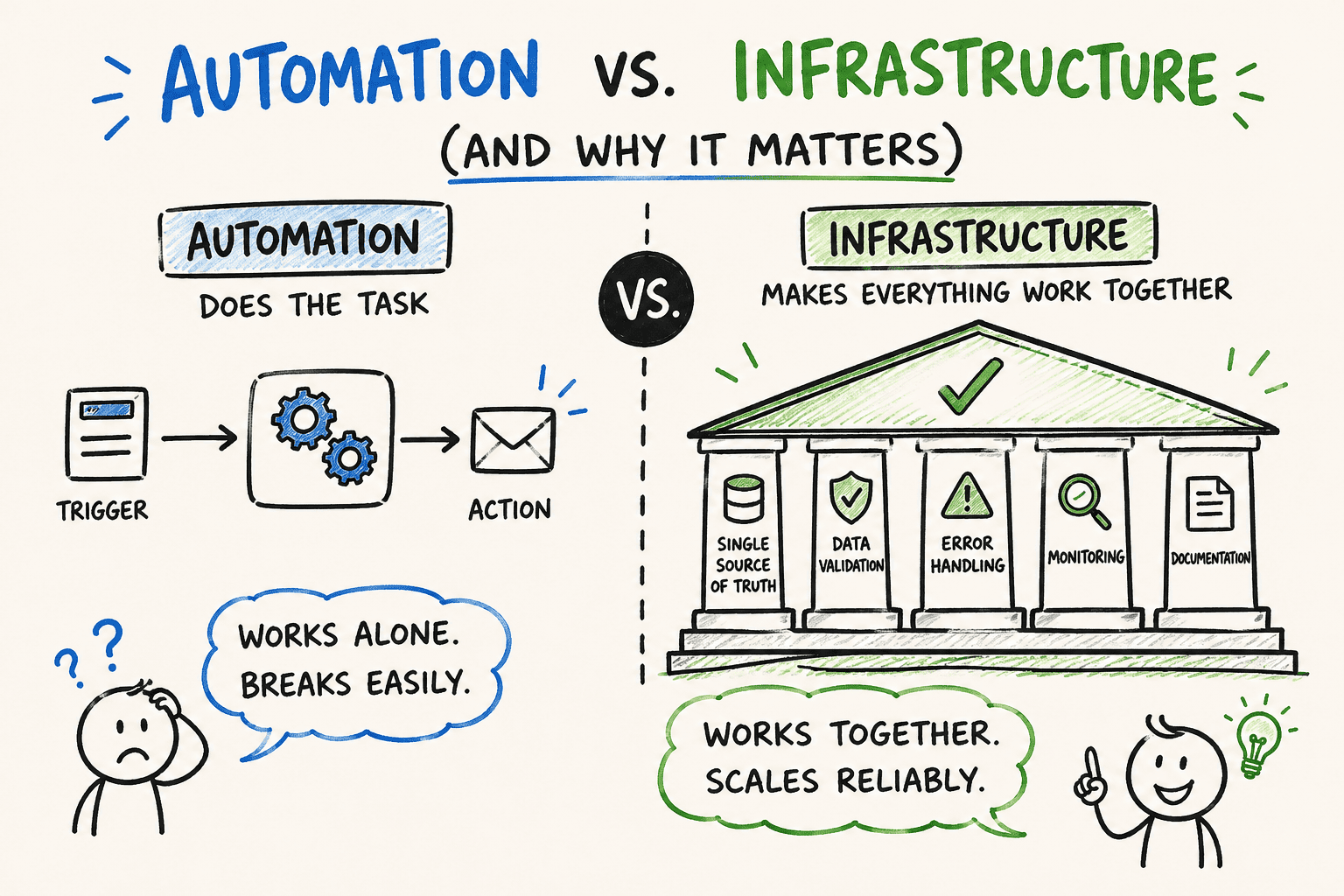
Automation is a workflow that does a task without manual effort. Infrastructure is the foundation that makes sure all your automations work together properly.
You can have automation without infrastructure. Lots of agencies do. They have 50 Zapier workflows. They have Make scenarios running in the background. They have GoHighLevel automations handling client communication.
But none of it is connected. None of it is monitored. None of it is documented.
When something breaks, nobody knows why. When someone leaves, nobody knows what they built. When you try to add a new tool, nobody knows what will break.
That is automation without infrastructure.
After working with 100+ agencies, the pattern is clear. Agencies that focus on building more automations without fixing the infrastructure underneath end up with more complexity, not less work.
What Automation Without Infrastructure Looks Like
Here is a real example.
A digital marketing agency running 30 clients. They had automations for everything. Lead capture, CRM updates, email sequences, reporting, onboarding, project management.
Every automation worked when it was built. But nothing worked together.
The onboarding automation created a CRM record and assigned a pipeline. But it did not trigger the reporting automation. So new clients did not show up on reports until someone manually added them.
The lead routing automation pulled data from Google Ads and created CRM records. But it did not validate phone numbers. So 15% of leads had invalid contact information and could not be reached.
The reporting automation pulled data from the CRM. But it assumed all required fields were filled out. When a field was empty, the report showed zero instead of flagging missing data.
Each automation worked in isolation. Together, they created chaos.
New clients onboarded but did not show up in reporting for weeks. Leads came in but could not be contacted. Reports went out with incomplete data and nobody noticed until clients complained.
The agency owner kept hiring contractors to build more automations. Fix this workflow. Add that integration. Connect these tools.
But every new automation made things worse. More dependencies. More failure points. More complexity.
That is what happens when you focus on automation without building infrastructure first.
What Infrastructure Actually Means
Infrastructure is not a tool. It is a system of practices that makes sure all your automations work together reliably.
Good infrastructure has five components:
Component 1: Single source of truth
All client data lives in one place. Not scattered across tools. Not duplicated in spreadsheets. One authoritative source.
For most agencies, that is the CRM. Every workflow that needs client data pulls from the CRM. Every workflow that creates or updates client data writes to the CRM.
If data exists in two places, one is wrong. Infrastructure eliminates the duplicates.
Component 2: Data validation
Every automation that writes data validates it first.
If a lead form submits without a required field, the automation stops and alerts someone. If a phone number has letters in it, the automation flags it. If a budget amount is negative, the automation rejects it.
Without validation, bad data gets into your system and spreads downstream. With validation, bad data gets caught at the entry point.
Component 3: Error handling
Every automation knows what to do when something fails.
If an API call times out, retry three times then alert someone. If a CRM record already exists, update it instead of creating a duplicate. If a required integration is disconnected, stop the workflow and send an urgent notification.
Without error handling, failures happen silently. With error handling, failures are loud and obvious.
Component 4: Monitoring
Every critical workflow has monitoring that checks if it is working.
If a lead comes in and does not create a CRM record within 5 minutes, send an alert. If a report runs but has zero line items, send an alert. If an automation skips a step, send an alert.
Monitoring does not wait for someone to notice something is broken. It tells you the moment it happens.
Component 5: Documentation
Every automation is documented in plain English.
What it does. When it runs. What data it uses. What other automations depend on it. What happens if it fails.
Documentation is not for the person who built it. It is for the person who has to maintain it after the builder leaves.
Why Infrastructure Comes First
Most agencies build automations first and try to add infrastructure later.
That does not work. Because once you have 50 disconnected automations, retrofitting infrastructure is harder than rebuilding from scratch.
You cannot add a single source of truth when client data already lives in 10 different places.
You cannot add validation when workflows have been writing bad data for months and that bad data is now embedded in reports, dashboards, and client deliverables.
You cannot add error handling when workflows have dependencies nobody documented and changing one thing breaks three others.
Infrastructure has to come first. Then you build automations on top of it.
How the Agency Infrastructure System (AIS) Works
The Agency Infrastructure System is not about building more automations. It is about building the foundation that makes all your automations work together properly.
Phase 1: Operations Clarity Walk
We audit everything running inside your agency. Not just individual workflows. How everything connects.
Which tools hold data. Which automations depend on each other. Where manual steps still exist. Where failure points hide.
You get a full walkthrough showing the current state and a reference sheet showing what is broken.
Phase 2: Client Delivery Rebuild
We consolidate your data into a single source of truth. Usually the CRM.
We add validation layers so bad data gets caught before it spreads. We add error handling so failures are obvious instead of silent. We rebuild your core workflows so they work together as a connected system.
Onboarding, lead routing, delivery. All pulling from the same source. All writing to the same place. All validated. All monitored.
Phase 3: Reporting and Visibility Layer
We automate reporting so every client gets the right update at the right time without manual work.
We build a team dashboard so your entire team knows where every client stands without asking anyone.
All data comes from the single source of truth. All reports are validated before sending. All failures trigger alerts.
Phase 4: Scale and Handoff
We document everything in plain English so your team can maintain it, modify it, and build on it without depending on the person who built it.
Every workflow has documentation. Every connection is mapped. Every edge case is covered.
When we hand off the system, your team owns it.
What This Changes
A performance marketing agency came to us with 40+ automations running across Zapier, Make, and GoHighLevel.
Everything worked in isolation. Nothing worked together.
Leads came in from Google Ads but did not sync to the CRM if the phone number format was wrong. Onboarding workflows created project folders but did not add clients to reporting. Reporting pulled data from three different sources that sometimes conflicted.
The founder was spending 15 hours per week troubleshooting failures and answering team questions about how things connected.
We rebuilt the infrastructure in 30 days.
Made the CRM the single source of truth. Added validation to every data entry point. Added error handling to every workflow. Added monitoring to every critical process. Documented every connection.
Three weeks after go-live, failures dropped by 80%. The founder’s troubleshooting time dropped from 15 hours per week to 2 hours per week. The team stopped asking how things connected because the documentation answered it.
Most importantly, they could finally add new automations without breaking existing ones. Because the infrastructure was solid.
Your Next Step
If you have dozens of automations but everything still feels fragile, the problem is not the automations. The problem is the lack of infrastructure underneath.
Book an Agency Systems Audit. We will show you exactly where your infrastructure is missing and how to build it properly so all your automations work together reliably.