
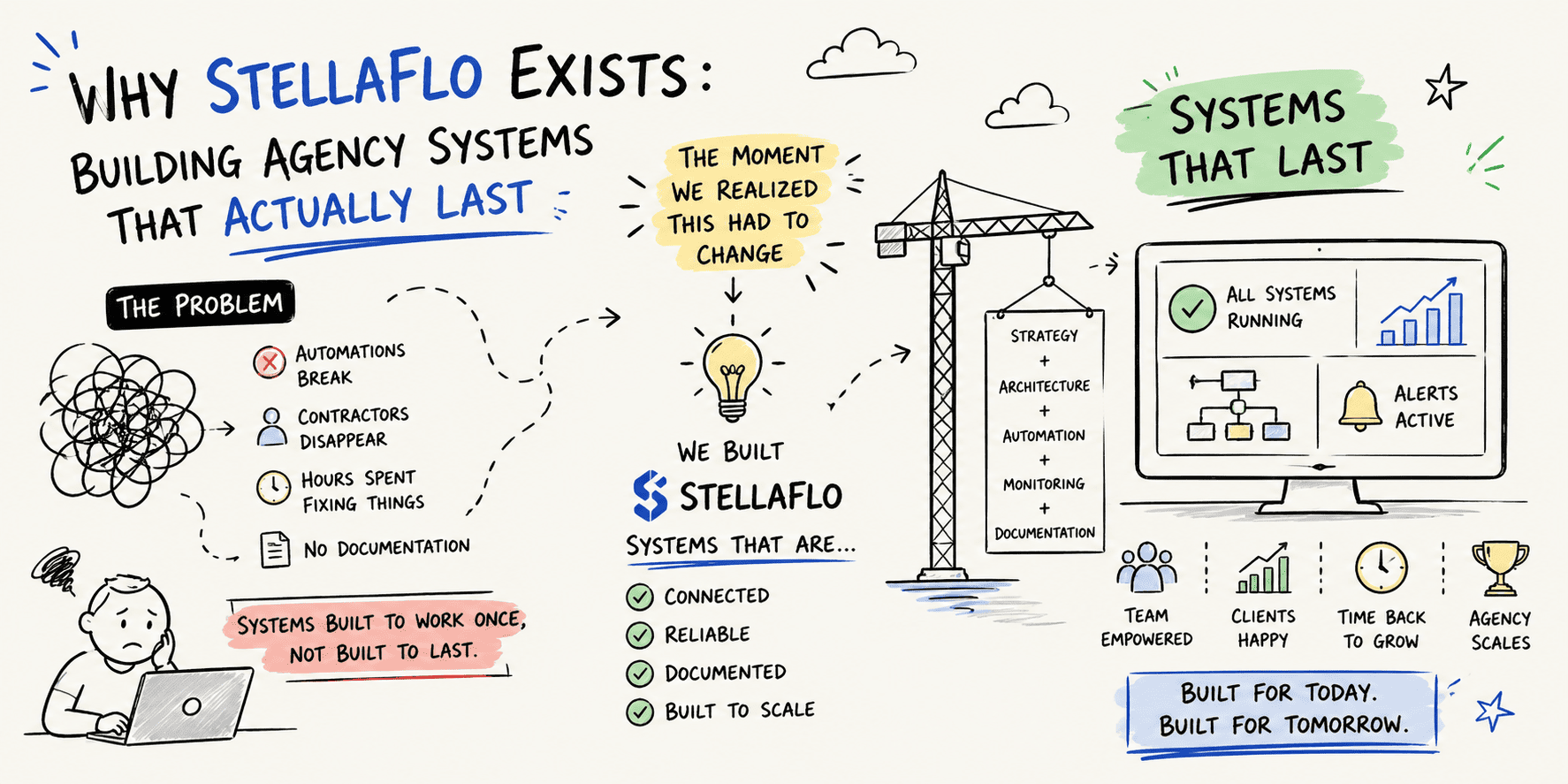
StellaFlo was not built because the market needed another automation agency.
It was built because we kept seeing the same problem everywhere.
Agencies hiring contractors to build automations. Those automations working for 3 months. Then breaking. Then the contractor being gone. Then the agency owner spending hours trying to figure out what broke and why.
After working with 100+ digital agencies over several years, the pattern was impossible to ignore.
The problem was never the automations themselves. The problem was how they were built.
Built in isolation. Built without documentation. Built to work once instead of built to last.
And when they broke, nobody could fix them. Because the person who built them was the only person who understood how they worked.
The Moment We Realized This Had to Change
A social media agency reached out in 2023. They were managing 25 clients. Revenue was growing. Team was solid. But operations were a disaster.
Every new client took 3 days to onboard. Reports went out late every month. Lead routing was breaking weekly. And the founder was spending 10 hours per week fixing things that should not need fixing.
They had hired three different contractors over two years to build automations.
The first contractor built the onboarding workflow in Zapier. It worked perfectly when they delivered it. Six months later, it started creating duplicate CRM records. Nobody knew why. The contractor had moved on to other projects and was not available.
The second contractor built the reporting automation in Make. It pulled data from Google Ads, Meta, and the CRM. It worked for 4 months. Then it stopped. The agency owner spent a week trying to figure out what broke. Turned out a CRM field name changed and the automation could not find the data anymore. Nobody documented which fields the automation depended on.
The third contractor built lead routing in GoHighLevel. It worked until a team member accidentally changed a pipeline setting. The entire routing system broke. Nobody knew how to fix it because nobody understood how it was supposed to work.
The agency owner was frustrated. They had spent over $15,000 on automations. All of them broke. None of them were documented. And they were back to doing everything manually.
When we audited their system, the issues were obvious.
None of the automations had error handling. When something went wrong, they just stopped working silently. No alerts. No notifications. The agency only found out when a client complained.
None of the automations had validation. If a lead form submitted without a required field, the automation still ran and created an incomplete CRM record.
None of the automations were documented. Not what they did. Not what data they used. Not what other automations depended on them.
And all three contractors had built in different tools using different approaches. There was no architectural consistency. No shared standards. Just three disconnected systems that happened to run in the same agency.
That was the moment we realized this problem was bigger than one agency.
What We Learned from 100+ Agency Audits
After that engagement, we started offering Operations Clarity Walks. Full audits of agency systems to show owners exactly what was running and where the failure points were.
Over the next two years, we ran 100+ of these audits.
Different agencies. Different sizes. Different tools. Different industries.
But the same problems appeared everywhere:
Problem 1: Automations built without considering what they connect to
Someone builds an onboarding workflow. It works. But it does not trigger the reporting automation. So new clients do not show up in reports until someone manually adds them weeks later.
Someone builds a lead routing workflow. It works. But it writes to a different CRM pipeline than the sales workflow expects. So leads go into the wrong funnel and conversion tracking breaks.
The individual automations work. But they do not work together. Because they were built in isolation without mapping out dependencies.
Problem 2: No monitoring or alerting
A critical workflow stops working. Nobody notices for two weeks. Leads are going to the wrong pipeline. Reports are missing data. Clients are getting incomplete updates.
The agency only finds out when a client emails asking why their report is wrong.
Monitoring was never built into the system. So failures happened silently.
Problem 3: Documentation does not exist
The person who built the automation leaves. Six months later, something needs to change.
Nobody knows how the automation works. Nobody knows what it connects to. Nobody knows what will break if they modify it.
So they rebuild it from scratch. Or they hire someone to reverse engineer it. Both options waste time and money.
Problem 4: Systems optimized for the happy path only
Automations are built assuming everything goes right. Lead forms are always filled out completely. APIs never time out. CRM records never have duplicate entries.
But in reality, things go wrong constantly. Forms submit with missing fields. APIs fail. Duplicates get created.
The automation does not know how to handle exceptions. So it either creates bad data or stops working entirely.
Problem 5: Founder becomes the bottleneck
Because nothing is documented and nothing is designed for team ownership, every question goes to the founder.
“Where does this client’s data live?”
“What pipeline should this lead go into?”
“Why did this automation stop working?”
The founder is the only person who knows how everything connects. So the agency cannot run without them.
Why We Built the Agency Infrastructure System (AIS)
After seeing these five problems in 100+ agencies, we realized the solution was not better automations.
The solution was better infrastructure.
Automations are easy to build. Infrastructure is hard.
But infrastructure is what makes automations last.
So we designed the Agency Infrastructure System (AIS) to solve all five problems at the foundation level.
Solution 1: Map everything before building anything
The Operations Clarity Walk is not just an audit. It is a complete map of how your agency’s systems connect.
Which workflows feed data into which other workflows. Which tools are the source of truth. Where manual steps still exist. Where single points of failure hide.
Before we rebuild anything, we show you the full picture. So when we build, we know exactly what connects to what.
Solution 2: Build monitoring into every critical workflow
Every workflow that matters has monitoring.
If a lead comes in and does not create a CRM record within 5 minutes, alert. If a report runs but has zero data, alert. If an automation skips a step, alert.
Failures are not silent. They are loud and immediate.
Solution 3: Document everything in plain English
Every workflow has documentation written for your team. Not technical specs. Plain English explanations.
What it does. When it runs. What data it uses. What happens if it fails. Which other workflows depend on it.
When someone leaves, the documentation stays. When someone needs to modify a workflow, the documentation tells them what will break.
Solution 4: Design for failure, not just success
Every workflow has validation and error handling.
If a lead form submits without a required field, the workflow stops and alerts someone. If an API call fails, the workflow retries three times then escalates. If a CRM record already exists, the workflow updates it instead of creating a duplicate.
We do not just design for the happy path. We design for every edge case the agency will encounter.
Solution 5: Remove the founder from daily operations
Everything is built so the team can operate independently.
Client data lives in one place. Workflows are documented. Approvals are automated. Monitoring alerts the team when something breaks.
The founder reviews exceptions. Not every task.
What Makes StellaFlo Different
Most automation agencies sell you workflows.
We sell you infrastructure.
Workflows are what you can see. A lead comes in. A CRM record gets created. A report gets sent.
Infrastructure is what you cannot see. The validation layer that catches bad data before it spreads. The error handling that prevents silent failures. The monitoring that alerts when something breaks. The documentation that lets your team maintain everything without depending on one person.
When you hire an automation agency, they build the workflow and leave.
When you work with StellaFlo, we rebuild your infrastructure so every workflow you add in the future works properly.
That is the difference.
What This Looks Like in Practice
The social media agency that sparked this entire approach came back to us in 2024.
We rebuilt their infrastructure in 30 days using AIS.
Operations Clarity Walk showed them exactly where their systems were fragile. Client Delivery Rebuild fixed their onboarding, lead routing, and reporting so everything pulled from a single source of truth. Reporting and Visibility Layer automated client updates and gave the team a dashboard showing every account status. Scale and Handoff documented everything so the team owned the system.
One year later, here is what changed:
Onboarding dropped from 3 days to 4 hours. They went from onboarding 4 clients per month to 10 without adding staff.
Reporting went from 8 hours of manual work per month to fully automated. Reports go out on the 1st of every month without anyone touching them.
System failures dropped by 85%. The few failures that happen get caught by monitoring before clients notice.
The founder went from spending 10 hours per week fixing systems to spending 1 hour per week reviewing exceptions.
Most importantly, they have added 6 new team members over the past year. Every new hire onboards without depending on the founder to explain how things work. Because the documentation explains it.
Why We Named It StellaFlo
Stella means star in Latin. Flo means flow.
Stars are constant. Reliable. Always there even when you cannot see them.
Flow is movement without friction. Systems that work smoothly without constant intervention.
That is what agency infrastructure should be. Constant. Reliable. Flowing smoothly without the founder in the middle.
StellaFlo exists to build that for agencies.
Your Next Step
If your agency’s systems feel fragile, if automations keep breaking, if you are the bottleneck in your own business, the problem is not your automations.
The problem is the infrastructure underneath.
Book an Agency Systems Audit. We will show you exactly where your infrastructure is weak and how to rebuild it so your agency runs without you in 30 days.
